Full Mouth Dental Implants - Rockville, MD
Renew Your Smile and Life
"I Put Off Going To The Dentist, Never Had Faith In Dentists; It Was Bad!"
Schedule NowGain Permanent, Attractive Teeth
The Ideal, Lasting Choice
Restoring a Permanent Smile
Phase One: Design and Planning
Every full mouth treatment begins with a personalized consultation with our implant dentist in Rockville, MD. This consultation gives us insight into your current situation and a chance to discuss your personal smile and health goals. We’ll complete digital x-rays and take impressions to help design your custom treatment plan. This personalized plan for a new smile will help provide a map of your surgery, fabricate custom surgical guides, and ultimately design your new smile. Completing all phases of your treatment in-house also ensures we maintain a superior level of personalization and care, while also being conscientious of your finances and budget.
Phase Two: Surgery and Immediate Teeth
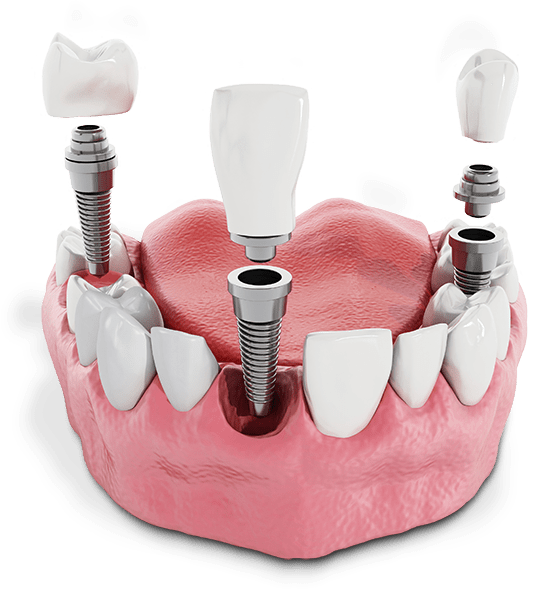
Our implant team has credentialing through the International Congress Of Oral Implantologists and has years of experience placing and restoring both titanium and ceramic dental implants. The surgical phase of your treatment will involve placing your dental implants, in addition to any preparatory procedures like teeth extraction and bone grafting. These may require a separate surgery but can often be done at the same time as implant placement. During this appointment, you’ll be comfortably resting under custom sedation while we place your dental implants using the custom surgical guide. This surgery is efficient and exacting, with predictable results that make it possible to attach a set of teeth immediately, in most cases. We work closely with a reputable dental lab to provide this same-day service, so you’ll never be without teeth!
Phase Three: Healing and Final Restoration
You’ll need several months to fully heal from surgery and to allow the dental implants and bone to integrate. This osseointegration is what provides a stable, permanent foundation for your new set of teeth. These teeth are fully custom, precision-designed in CAD/CAM technology from a block of zirconia exactly to your specifications, so they provide the most realistic and beautiful result. Once attached to the dental implants, they’ll provide lasting and stable function while looking and feeling completely natural. When properly maintained, your new smile will last decades and potentially the rest of your life!
Invest in a Lifetime of Healthy, Happy Smiles
Full mouth dental implants in Rockville, MD are a life-long investment in the quality of your life, from your self-confidence to your ability to enjoy eating, socializing, and relationships. Don’t let the opportunity pass by because of financial concerns! Along with repairing failed dental implants free of charge, our office provides numerous payment options and dental financing through CareCredit®. Financing gives you the freedom to complete more extensive treatment like full mouth restoration, without worrying about upfront costs. Applying for CareCredit is fast and easy, with instant decisions and immediate funding on many cases. Most patients qualify for the loan they need and receive personalized payment plans with fixed interest rates and no prepayment penalties! Contact our team at State of the Art Dental Group to learn about your payment and financing solutions and begin your journey to a lifetime of healthy, happy smiles.
Full Mouth dental Implants FAQ
Full mouth dental implants are a fixed, permanent solution for replacing an entire arch (or both arches) of missing or failing teeth. Instead of resting on the gums like a traditional denture, a full arch of custom teeth is anchored to 4–6 implants that are surgically placed in the jawbone. Because the new teeth are secured directly to the bone, they restore significantly more chewing function than a removable denture and don’t shift, click, or need adhesive. You can read a full breakdown of the process on our full mouth dental implants page and in our comprehensive guide to full mouth dental implants.
Most patients who are missing most or all of their teeth in an arch — or who have failing teeth, advanced gum disease, or ill-fitting dentures — are potential candidates. Good candidates typically have enough jawbone density to support implants (or are candidates for bone grafting), are in reasonably good general health, and don’t have uncontrolled conditions like diabetes or active gum infection. The only way to know for certain is a consultation with digital imaging, which our team offers as part of a full mouth dental implant consultation. The American Dental Association also outlines general candidacy considerations for dental implants if you’d like a neutral third-party overview.
Cost varies based on how many implants are placed, whether bone grafting or extractions are needed, and the type of final restoration (such as zirconia). Traditional dental insurance often covers only a portion of implant treatment, since it’s frequently classified differently than routine care. To make treatment accessible, our practice offers financing options including CareCredit, along with current promotions. You can see specific numbers and payment options on our costs, procedure, and benefits page and our dental financing and insurance page.
Treatment generally happens in three phases: planning (a consultation with digital scans and a custom treatment plan), surgery (implant placement, often with same-day temporary teeth), and final restoration (a custom, permanent set of teeth placed after the implants have fully healed and fused with the jawbone, a process called osseointegration). Many patients leave surgery with a functional temporary smile the same day. For a step-by-step walkthrough, see what a typical full mouth dental implant procedure looks like.
Most patients manage initial discomfort with prescribed or over-the-counter pain medication, and swelling typically subsides within a week or two. You’ll generally be back to normal activities within a few days, though a soft-food diet is recommended for several weeks while the surgical sites heal. Full integration of the implants with the jawbone — needed before the final, permanent restoration is placed — usually takes a few months. Your care team will give you a personalized recovery timeline based on your treatment plan.
With proper care, the implants themselves can last decades — often a lifetime — since titanium fuses directly with the jawbone. The visible restoration (the prosthetic teeth) typically lasts 10–15+ years before it may need refinement or replacement due to normal wear. Longevity depends heavily on oral hygiene, regular dental checkups, and habits like avoiding teeth grinding or tobacco use. Compare this to the function and lifespan of other options on our implant-supported dentures page, which also explains the difference between fixed and removable implant options.
A traditional denture rests on the gums and is removed daily; it restores only a fraction of natural biting force and can slip or require adhesive. Implant-supported (removable) dentures snap onto a small number of implants for added stability but still come out for cleaning. Full mouth dental implants, by contrast, are fixed in place like natural teeth and are not removed by the patient. If you’re weighing which option fits your lifestyle and budget, this comparison is explained in detail on our page addressing the difference between implant-supported dentures and full mouth dental implants, as well as our full and partial dentures page for context on traditional options.
Our Patients tell the story best
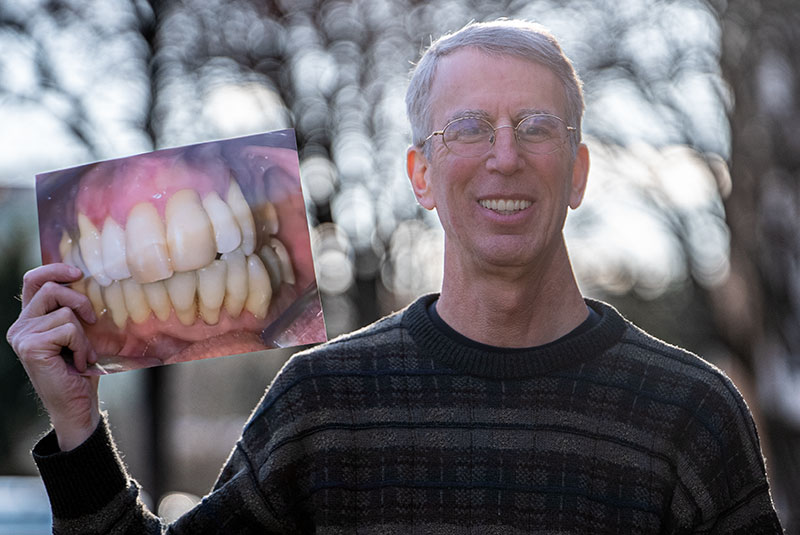
"If I Waited Longer, My Entire Health Could've Been Compromised"
Neil - AOX

Are You A Candidate
For Dental Implants?
Answer The Following Questions To Learn More About Our Pricing & Financing Options!